
 16 Mar 2026
Market Update Summary - Mar 16
Abstract
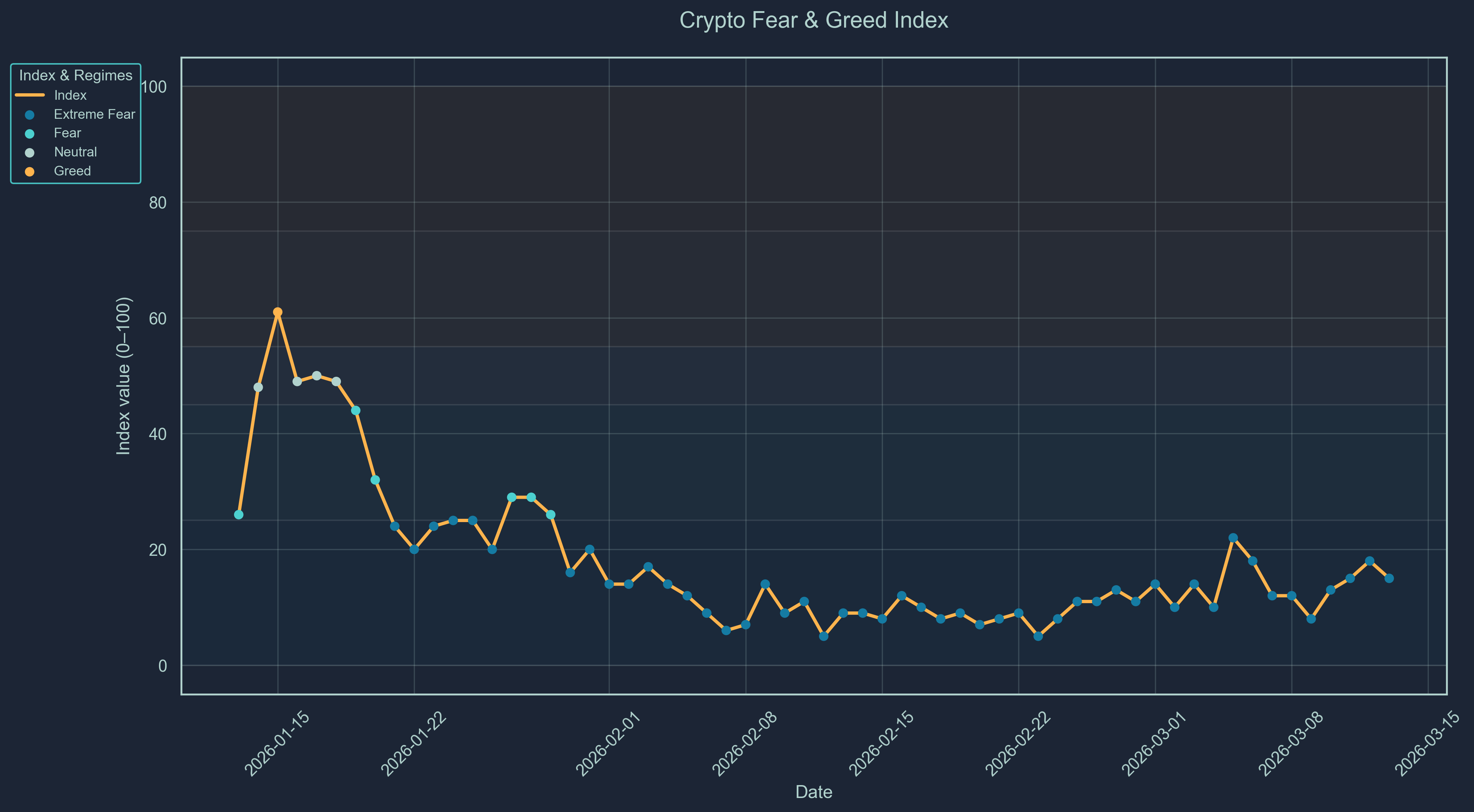
The digital asset market remains locked in a state of extreme fear, with the Crypto Fear-and-Greed Index tightening further to 15. Despite a notable 30-day recovery across major tokens, led by ETH (+12.07%) and SOL (+12.93%), sentiment is heavily weighed down by a decoupling from traditional equities, as the S&P 500 slumped 4.15% over the same period. This defensive posture is reinforced by an Altseason Indicator of 43.0, signaling a continued "Bitcoin-biased transition" where capital is concentrated in the most established assets.
Key highlights from this week’s report:
Market Dynamics: While crypto prices have shown resilience over the last month (BTC +8.87%), the "extremely fearful" rating reflects deep-seated anxiety regarding macro volatility. We are currently in a "mixed zone" where crypto is outperforming traditional benchmarks like SPX and Gold but failing to spark a broader altcoin rally.
Tokenization Gains Ground: The SEC Investor Advisory Committee has formally backed a push for tokenized securities. By proposing limited "innovation exemptions," the committee is clearing a path for blockchain-based trading to modernize Wall Street, provided strict transparency and audit guardrails are met.
Smart Money Trends: Capital is rotating into hype-based "meme" Solana-based projects, with PUNCH and BUTTCOIN leading 7-day inflows. Conversely, sophisticated traders are exiting "stale" positions in larger-cap laggards like STRK and WLD, signaling a pivot toward high-alpha, small-cap opportunities.
Bottom Line: The market is witnessing a profound divergence. While short-term sentiment is suppressed by macro headwinds, the underlying infrastructure is evolving rapidly. From the SEC's nod toward tokenization to the race for AI-agent settlement, the long-term integration of crypto into the global financial and digital fabric continues to accelerate despite the prevailing "extreme fear."
Market Sentiment
Market sentiment remains deflated following wider macro pressure spreading to the crypto market, despite a small rally led by BTC, with our Crypto Fear-and-Greed index sitting at 15 (Scale 0-100), an extremely fearful rating. Market sentiment indicates a reversion to a fear of volatile assets. In combination with the altseason indicator, we indicate the market is currently extremely fearful and risk-off.
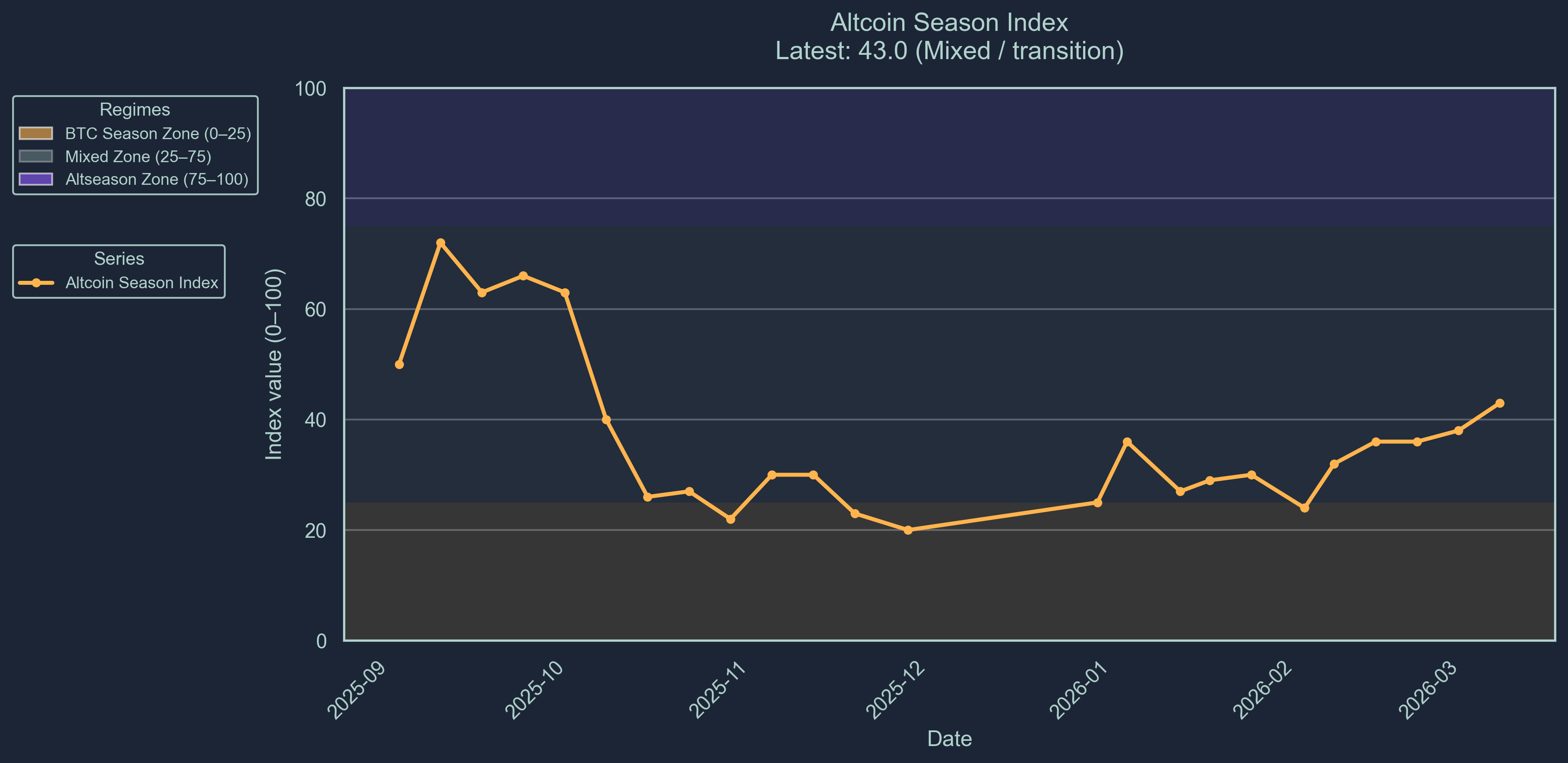
The altseason indicator is indicating a a Bitcoin biased transition season. The altseason indicator sits at 43.0 (Scale 0-100). This score represents that only 43% of altcoins included in the Top-100 index outperformed Bitcoin over the previous 90 days. Bitcoin season is interpreted as a bearish signal in the market. We are now entering the mixed zone, a positive sentiment for the new year.
Major Token Performance Performance
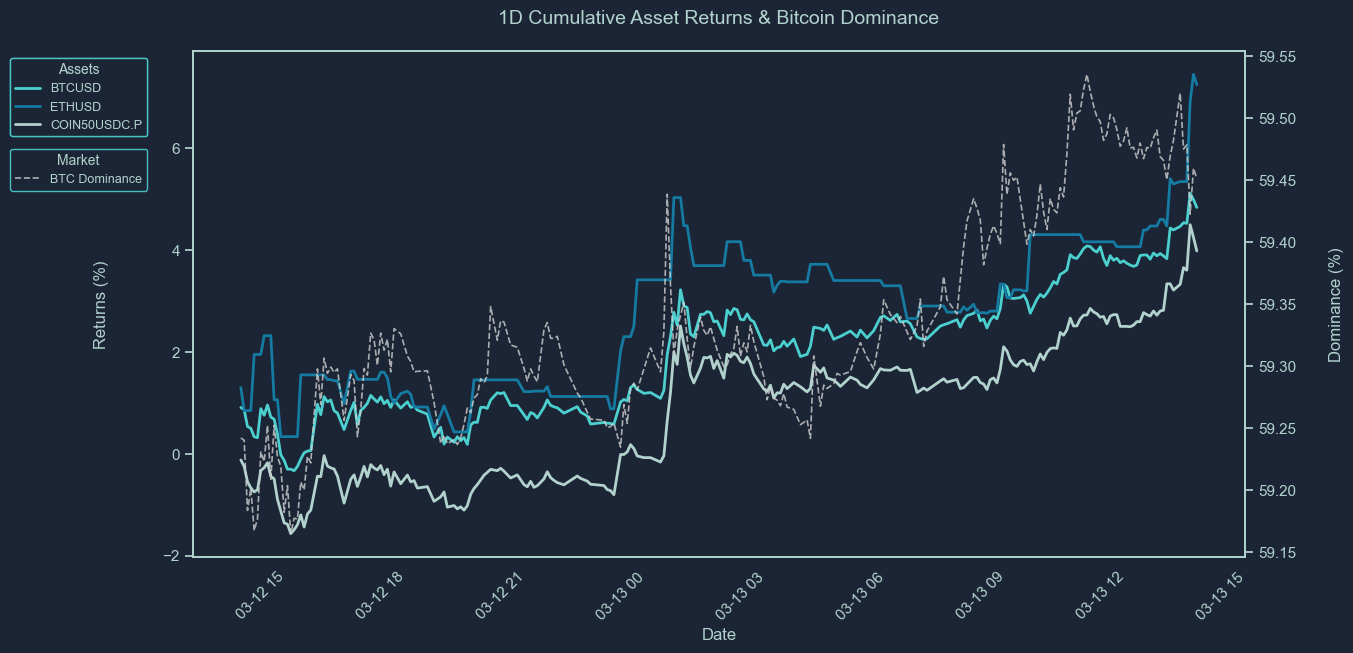
How to Read These Charts
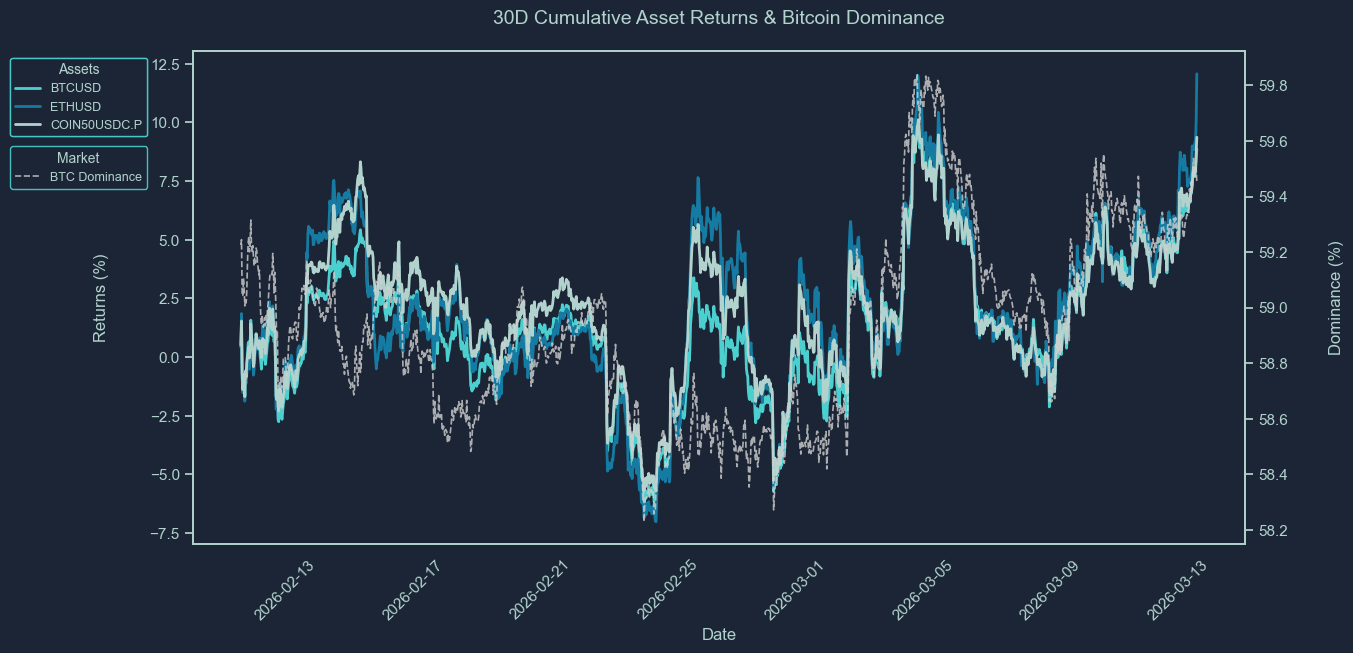
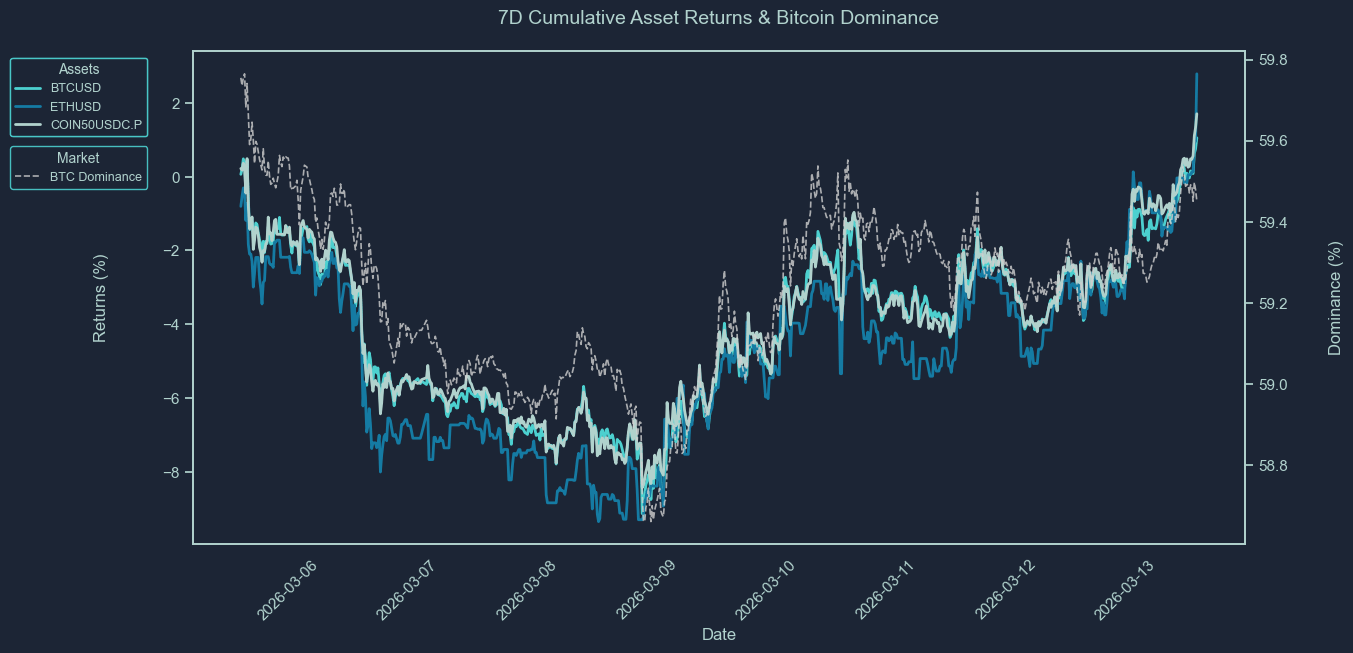
These charts show the cumulative price returns of Bitcoin (BTC), Ethereum ETH), and the COIN50 index over the selected periods; 30 days, 7 days or 24 hours. Returns are rebased to 0% at the start of each period to highlight relative performance trends between assets.
The BTC dominance line (secondary axis) tracks Bitcoin’s share of the total crypto market capitalization, offering context on capital rotation between BTC and altcoins. Rising BTC dominance typically indicates capital consolidation into Bitcoin, while a decline suggests increased risk appetite and flows into altcoins.
Use these charts to quickly assess:
Which assets outperformed or underperformed over the period
Whether market strength was concentrated (BTC-led) or broad-based
How shifts in BTC dominance align with overall performance trends
Asset | 30D Change | 7D Change | 1D Change | Price |
BTCUSD | 8.87% | 1.05% | 4.84% | 73,066.51 |
ETHUSD | 12.07% | 2.79% | 7.04% | 2183.49 |
XRPUSD | 4.43% | 0.71% | 3.48% | 1.4368 |
BNBUSD | 14.50% | 3.82% | 4.84% | 677.38 |
SOLUSD | 12.93% | 0.36% | 6.79% | 91.63 |
COIN50USDC.P | 9.36% | 1.71% | 3.98% | 288.58 |
XAUUSD | 0.51% | -1.08% | -1.23% | 5109.12 |
SPX | -4.15% | -2.47% | -0.73% | 6672.61 |
How to Read This Table
This table summarizes the percentage price change of key crypto and macro assets over three timeframes: 30 days, 7 days, and 24 hours. It includes major cryptocurrencies (e.g., BTC, ETH, XRP, SOL), a benchmark altcoin index (COIN50), and traditional market comparables like gold (XAU) and the S&P 500 (SPX).
The data allows you to:
Compare short-term and medium-term performance across sectors
Spot momentum leaders and laggards in both crypto and traditional markets
Assess whether market moves were broad-based or asset-specific
Track how crypto assets performed relative to macro benchmarks
This table provides a concise view of market dynamics across different asset classes and helps contextualize crypto performance within a broader macro landscape.
Smart Money Flows
Top 10 7D Flows
Asset | Chain | 24H Flow | 7D Flow | 30D Flow | Market Cap |
PUNCH | solana | 2.54K | 13.49K | -201.23K | 6.18M |
BUTTCOIN | solana | 0.00 | 11.62K | 4.63K | 12.42M |
NEET | solana | 0.00 | 10.17K | 114.72K | 29.28M |
LOBSTAR | solana | 0.00 | 8.98K | -27.74K | 3.34M |
MOCA | ethereum | 7.43K | 7.43K | 7.43K | 60.02M |
MUSHU | solana | 0.00 | 6.51K | 6.44K | 552.57K |
KILROY | solana | 0.00 | 6.45K | 4.27K | 482.23K |
TESTICLE | solana | -1.13K | 5.91K | -22.94K | 3.07M |
OPENCLAW | solana | 0.00 | 5.82K | 3.89K | 312.82K |
CORVUS | solana | 0.00 | 4.50K | 4.50K | 175.60K |
Bottom 10 7D Flows
Asset | Chain | 24H Flow | 7D Flow | 30D Flow | Market Cap |
REZ | ethereum | 0.00 | -185.83K | -266.36K | 23.76M |
STRK | ethereum | 0.00 | -183.58K | -188.61K | 230.90M |
TROLL | solana | -127.42K | -127.42K | -165.73K | 14.48M |
ATH | ethereum | -83.84K | -95.75K | -273.31K | 113.80M |
NAORIS | ethereum | 0.00 | -56.45K | -56.45K | 41.36M |
USELESS | solana | 0.00 | -52.30K | -48.17K | 40.99M |
CYBER | ethereum | -6.85K | -51.76K | -75.53K | 33.51M |
OHM | ethereum | -11.94K | -29.49K | -29.49K | 267.06M |
WLD | ethereum | 0.00 | -23.43K | -99.98K | 1.09B |
BIO | ethereum | 0.00 | -22.21K | -454.96K | 37.84M |
These tables track the weekly movement of "smart money" wallets across various tokens and chains.
The Top 10 7D Flows table highlights assets that have seen the largest net inflows from smart money in the past 7 days. A high and rising 7D flow suggests growing interest, accumulation, or conviction by sophisticated traders, and may indicate strong underlying narratives or catalysts. Compare these flows with the token’s market cap to assess relative impact, inflows into small-cap assets are generally more price-sensitive.
Conversely, the Bottom 10 7D Flows table shows tokens with the largest net outflows from smart money wallets. Persistent or large outflows may reflect profit-taking, loss-cutting, or reduced confidence, and can signal weakening sentiment or fading momentum. Watch for sustained outflows alongside declining price or on-chain activity.
Use these tables to:
Identify tokens where smart money is actively positioning
Spot emerging narratives or sentiment reversals
Gauge chain-specific flows, e.g., Solana vs. Ethereum vs. Base
Inform rotational strategies across high-alpha tokens
Macro & Crypto News
March 15: Visa and Coinbase Pivot Toward AI Agent Economies with Divergent Infrastructure
As autonomous AI agents begin to transition from simple chatbots to economic actors capable of executing transactions, payment giants Visa and Coinbase have unveiled competing visions for the "Internet of Agents." While both companies agree that AI-to-AI commerce is the next frontier, their technical approaches highlight a fundamental split between traditional finance and blockchain-native settlement.
Visa’s strategy centers on adapting its existing global network to handle machine-to-machine payments. By leveraging virtual card technology and established fiat rails, Visa aims to provide AI agents with the "credentials" needed to interact with the current economy. This approach prioritizes regulatory compliance and seamless integration with legacy banking systems, positioning Visa as the essential bridge for AI labs that want their agents to pay for API credits, cloud storage, or physical goods within the traditional retail world.
In contrast, Coinbase is building for a "crypto-native" AI future, utilizing its Layer-2 network, Base, and stablecoins like USDC. Coinbase’s model allows AI agents to have their own on-chain wallets, enabling them to execute programmable, near-instant transactions without needing a traditional bank account or a human intermediary. This vision emphasizes a permissionless "agentic web," where software can autonomously earn, save, and spend value in a decentralized environment.
The competition between these two titans underscores a looming architectural debate: will the AI economy remain tethered to sovereign fiat systems, or will it accelerate the shift toward a borderless, blockchain-based financial layer? As AI agents become more prevalent, the choice between Visa’s "trusted rails" and Coinbase’s "open rails" may define the efficiency and autonomy of the next generation of the internet.
March 12: SEC Advisory Group Backs Tokenized Securities Push, Outlines Safety Framework
The U.S. Securities and Exchange Commission’s (SEC) Investor Advisory Committee has formally voted to approve a set of recommendations aimed at advancing the regulatory framework for tokenized securities. The move signals a major shift toward modernization, potentially allowing blockchain-based stock trading to bypass the legacy intermediary settlement models that have defined Wall Street for decades.
To facilitate this transition, the committee proposed granting limited exemptions for blockchain-based trading, provided strict safety guardrails are maintained. These requirements include mandatory transparency through disclosure, regular external audits, and rigorous "best execution" standards to ensure retail investors are not disadvantaged by the shift to on-chain environments.
Despite the push for innovation, the SEC reaffirmed that tokenized assets remain legally classified as securities. Officials emphasized that while the technology changes, the underlying risks, such as market manipulation and custody failures, require safeguards equivalent to those in traditional finance. The committee specifically warned that any new exemptions must not introduce hidden costs or systemic risks that outweigh the efficiency gains of tokenization.
The endorsement is expected to pave the way for a formal "innovation exemption" in the near future, allowing for controlled, limited-scale trading of tokenized assets. This step represents a critical bridge toward a long-term regulatory architecture that integrates distributed ledger technology into the heart of the U.S. capital markets.
THE CONTENT ON THIS WEBSITE IS NOT FINANCIAL ADVICE
The information provided on this website is for information purposes only and does not constitute investment advice with respect to any assets, including but not being limited to, commodities and digital assets. This website and its contents are not directed to, or intended, in any way, for distribution to or use by, any person or entity resident in any country or jurisdiction where such distribution, publication, availability or use would be contrary to local laws or regulations. Certain legal restrictions or considerations may apply to you, and you are advised to consult with your legal, tax and other professional advisors prior to contracting with us.